Freedom Fighters - I
Honoring the brave souls who dedicated their lives to the independence and integrity of our motherland.
Impact of the Hindu–German Conspiracy
The Hindu–German Conspiracy failed to engage popular support within India. However, it had a significant impact on Britain's policies within the empire and international relations. The outlines and plans for the nascent ideas of the conspiracy were noted, and tracking by British intelligence began as early as 1911. Alarmed at the agile organization, which repeatedly reformed in different parts of the country despite being subdued in others, the chief of Indian Intelligence Sir Charles Cleveland was forced to warn that the idea and attempts at pan-Indian revolutions were spreading through India "like some hidden fire." A massive, concerted and coordinated effort was required to subdue the movement. Attempts were made in 1914 to prevent the naturalisation of Tarak Nath Das as an American citizen, while successful pressure was applied to have Har Dayal interned. The conspiracy had been detected early by British intelligence, and had been the subject of British pressure from 1914.
INA treasure controversy
Alleged misappropriation by men of Azad Hind
The INA treasure controversy relates to alleged misappropriation by men of Azad Hind of the Azad Hind fortune recovered from belongings of Subhas Chandra Bose in his last known journey. The treasure, a considerable amount of gold ornaments and gems, is said to have been recovered from Bose's belongings following the fatal plane crash in Formosa that reportedly killed him, and taken to men of Azad Hind then living in Japan. The Indian government was made aware of a number of these individuals allegedly using part of the recovered treasure for personal use. However, despite repeated warnings from Indian diplomats in Tokyo, Nehru is said to have disregarded allegations that men previously associated with Azad Hind misappropriated the funds for personal benefit. Some of these are said to have travelled to Japan repeatedly with the approval of Nehru government and were later given government roles implementing Nehru's political and economic agenda. A very small portion of the alleged treasure was repatriated to India in the 1950s.

Inayatullah Khan Mashriqi
Pakistani mathematician (1888–1963)
Inayatullah Khan Mashriqi, also known by the honorary title Allama Mashriqi, was a British Indian, and later, Pakistani mathematician, logician, political theorist, Islamic scholar and the founder of the Khaksar movement.

Independence Day (India)
Public holiday celebrated on 15 August
Independence Day is celebrated annually on 15 August as a public holiday in India commemorating the nation's independence from the United Kingdom on 15 August 1947. On this day the Indian Independence Act 1947 came into effect, transferring legislative sovereignty to the Indian Constituent Assembly. India attained independence following the independence movement noted for largely non-violent resistance and civil disobedience led by Indian National Congress under the leadership of Mahatma Gandhi.
India Defence League
The India Defence League was a British pressure group founded in June 1933 dedicated to keeping India within the British Empire.
Indian Empire Society
Organisation promoting British imperialism in the Indian subcontinent
The Indian Empire Society was a London-based lobbying organization, formed in 1930 to promote the cause of the British Indian Empire.
Indian Home Rule movement
Anti-colonial movement in British India
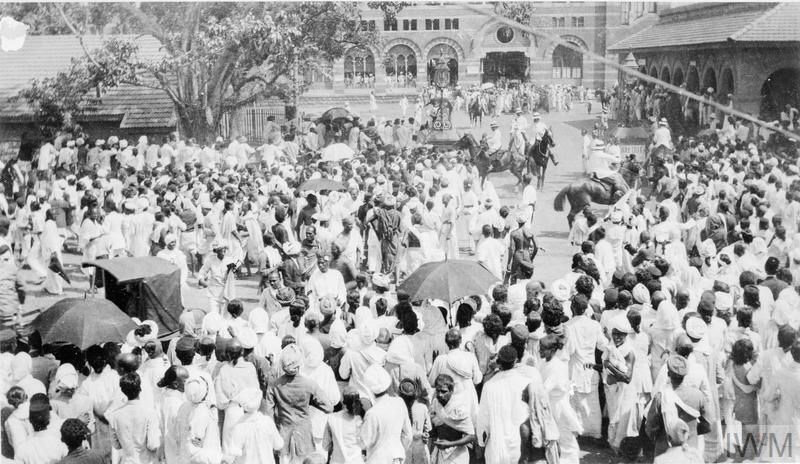
The Indian Home Rule movement was a movement in British India on the lines of the Irish Home Rule movement and other home rule movements. The movement lasted around two years between 1916–1918 and is believed to have set the stage for the Indian independence movement under the leadership of Annie Besant and Bal Gangadhar Tilak to the educated English-speaking upper class Indians. In 1920, All India Home Rule League changed its name to Swarajya Sabha.
Indian Home Rule Society
Organisation founded in 1905 in London
The Indian Home Rule Society (IHRS) was an Indian organisation founded in London in 1905 that sought to promote the cause of self-rule in British India. The organisation was founded by Shyamji Krishna Varma, with support from a number of prominent Indian nationalists in Britain at the time, including Bhikaji Cama, Dadabhai Naoroji and S.R. Rana, and was intended to be a rival organisation to the British Committee of the Indian National Congress that was the main avenue of the loyalist opinion at the time.
Indian Independence League
Political organization
The Indian Independence League was a political organisation operated from the 1920s to the 1940s to organise those living outside British India into seeking the removal of British colonial rule over the region. Founded by Indian nationalists, its activities were conducted in various parts of Southeast Asia. It included Indian expatriates, and later, Indian nationalists in-exile under Japanese occupation following Japan's successful Malayan Campaign during the first part of the Second World War. During the Japanese Occupation of Malaya, the Japanese encouraged Indians in Malaya to join the League.

Indian independence movement
Movement to end British rule in India
The Indian independence movement was a series of political efforts from the middle of the nineteenth century to 1947, that took place in the Indian subcontinent with the aim of ending British colonial rule.
Indian Legion
Indian volunteer unit in Nazi Germany
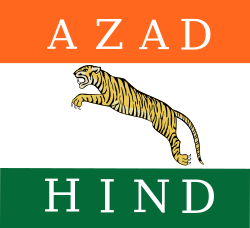
The Indian Legion, officially the Free India Legion or 950th (Indian) Infantry Regiment, was a military unit raised during the Second World War initially as part of the German Army and later the Waffen-SS from August 1944. Intended to serve as a liberation force for British-ruled India, it was made up of Indian prisoners of war and expatriates in Europe. Owing to its origins in the Indian independence movement, it was known also as the "Tiger Legion", and the "Azad Hind Fauj". As part of the Waffen-SS it was known as the Indian Volunteer Legion of the Waffen-SS. The transfer to the Waffen-SS was never fully executed and many members of the division refused to wear the new uniforms and insignia.

Indian National Army
Army of Indian POWs taken Japan in WW2 and enlisting civilians
The Indian National Army was a Japanese-allied and -supported armed force constituted in Southeast Asia during World War II and led by Indian anti-colonial nationalist Subhas Chandra Bose. It consisted primarily of British Indian Army POWs taken by Japan. Indian civilians in the region were also enlisted, with around 18,000 joining. The INA aimed to liberate India from British rule. After winning Japanese assent for its goal, the INA furnished support to the Japanese Army. The Japanese and INA forces invaded India from Rangoon in 1944, and Bose's nominal Provisional Government of Azad Hind declared war on Britain. Losses inflicted by the British in the Battle of Imphal in Manipur caused the invasion to be halted. A long and exhausting withdrawal, accompanied by a lack of supplies, malnutrition, and death, ensued, some victorious soldiers in the Indian Army not taking INA battlefield surrender kindly. The remaining INA was driven down the Malay Peninsula and surrendered to Allied forces in August 1945.
Indian National Army in popular culture
INA in popular culture
The Indian National Army (INA) and its leader Subhash Chandra Bose are popular and emotive topics within India. From the time it came into public perception in India around the time of the Red Fort Trials, it found its way into the works of military historians around the world. It has been the subject of a number of projects, of academic, historical and of popular nature. Some of these are critical of the army, some — especially of the ex-INA men — are biographical or autobiographical, while still others historical and political works, that tell the story of the INA. A large number of these provide analyses of Subhas Chandra Bose and his work with the INA.

Indian National Army trials
British Indian trial by courts-martial
The Indian National Army trials was the British Indian trial by court-martial of a number of officers of the Indian National Army (INA) between November 1945 and May 1946, on various charges of treason, torture, murder and abetment to murder, during the Second World War.

Indian National Association
Former nationalist organization of India
The Indian Association was the first avowed nationalist organization founded in British India by Surendranath Banerjee and Ananda Mohan Bose in 1876. The objectives of the Association were for "promoting by every legitimate means the political, intellectual and material advancement of the people". The Association attracted educated Indians and civic leaders from all parts of the country and became an important forum for India's aspirations for independence. It later merged with the Indian National Congress.

Indian National Congress
Indian political party
The Indian National Congress (INC), also known as the Congress Party, or simply the Congress, is a big tent political party in India. It is one of the two major Indian political parties alongside the Bharatiya Janata Party, and the oldest party in India. Founded on 28 December 1885, it was the first modern nationalist movement to emerge in the British Empire in Asia and Africa. From the late 19th century, and especially after 1920, under the leadership of Mahatma Gandhi, the Congress became the principal leader of the Indian independence movement. The Congress was one of the parties who led India to independence from the United Kingdom, and significantly influenced other anti-colonial nationalist movements in the British Empire.
Indian National Council
The Indian National Council was an organisation founded in December 1941 in Bangkok by Indian Nationalists residing in Thailand. The organisation was founded from the Thai-Bharat Cultural Lodge on 22 December 1941. The founding president of the council was Swami Satyananda Puri, along with Debnath Das as the founding secretary. Along with the Indian Independence League, it came to be one of the two prominent Indian associations that corresponded with I Fujiwara's F Kikan on the scopes of Japanese assistance to the Indian movement.

Indian People's Theatre Association
Indian theatre company organization
Indian People's Theatre Association (IPTA) is the oldest association of theatre-artists in India. IPTA was formed in 1943 during the British rule in India, and promoted themes related to the Indian freedom struggle. Its goal was to bring cultural awakening among the people of India.

India's Struggle for Independence
1987 book
India's Struggle for Independence is a book written by historians Bipan Chandra, Mridula Mukherjee, Aditya Mukherjee, Sucheta Mahajan, and K. N. Panikkar, and published by Penguin Random House in 1987. The book examines the Indian independence movement.
Inquilab Zindabad
Hindustani phrase meaning "Long live the revolution"
Inquilab Zindabad is a Hindustani phrase, which translates to "Long live the revolution". Although originally the slogan was used by Indian independence movement activists in the British Indian Empire, today it is used in Bangladesh, India and Pakistan by civil society activists during protests as well as by politicians from various ideological backgrounds.

Interim Government of India
1946–1947 provisional government
The Interim Government of India, also known as the Provisional Government of India, formed on 2 September 1946 from the newly elected Constituent Assembly of India, had the task of assisting the transition of British India to independence. It remained in place until 15 August 1947, the date of the independence of British India, and the creation of the dominions of India and Pakistan.