1857 War of Independence
1857–1858
The first holistic national uprising against foreign rule.
Historical Timeline
7th Century - 1947
Heroes of this Period (13)
Ahmadullah Shah
Leader of the Indian Rebellion of 1857 (1787–1858)
Ahmadullah Shah famous as the Maulvi of Faizabad, was a famous freedom fighter and leader of the Indian Rebellion of 1857. Maulavi Ahmadullah Shah was known as the lighthouse of the rebellion in the Awadh region. British officers like George Bruce Malleson and Thomas Seaton made mentions about the courage, valour, personal and organizational capabilities of Ahmadullah. G. B. Malleson mentions Ahmadullah repeatedly in the History of Indian Mutiny, a book written in 6 volumes covering Indian revolt of 1857. Thomas Seaton describes Ahmadullah Shah as:A man of great abilities, of undaunted courage, of stern determination, and by far the best soldier among the rebels.

Azimullah Khan
Leader of the Indian Rebellion of 1857
Azimullah Khan Yusufzai also known as Dewan Azimullah Khan and Krantidoot, was the ideological leader of the Indian Rebellion of 1857. He was initially appointed Secretary, and later Prime Minister to Maratha Peshwa Nana Saheb II.
Durjan Singh
Leader of Chuar Rebellion
Durjan Singh was a great leader of Chuar Rebellion of Bengal. Singh was a zamindar of Raipur in the Bishnupur district of Bengal. He led the Chuar Rebellion in 1798–99 in Midnapore district against the British East India Company, but it was brutally crushed at its peak..
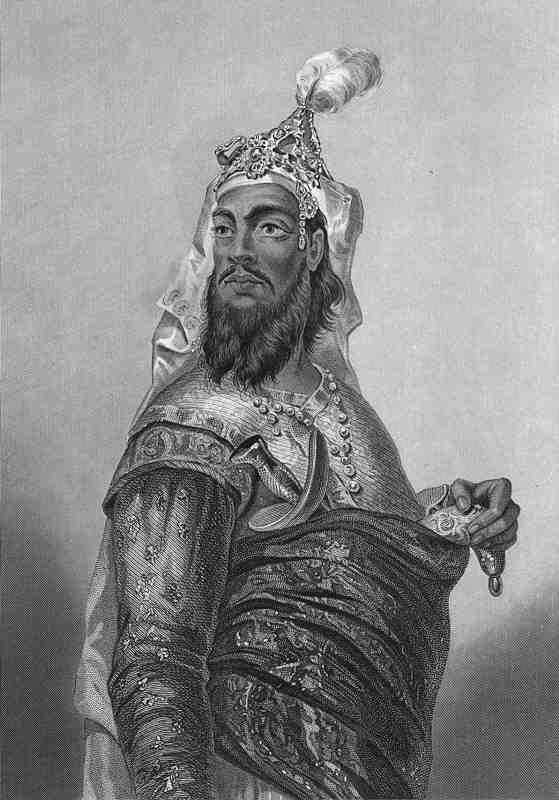
Kunwar Singh
Leader of the Indian rebellion of 1857
Veer Kunwar Singh, also known as Babu Kunwar Singh was a chief organiser of the Indian Rebellion of 1857 from the Bhojpur region of Bihar. He was originally the ruler of Jagdishpur estate. He led a selected band of armed soldiers against the troops under the command of the British East India Company.
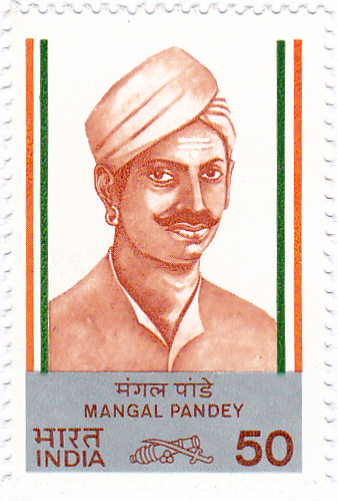
Mangal Pandey
Indian soldier and freedom fighter (1827–1857)
Mangal Pandey was an Indian soldier who played a key role in the events that led to the Indian Rebellion of 1857, which resulted in the dissolution of the East India Company and the beginning of the British Raj through the Government of India Act 1858. He was a sepoy in the 34th Regiment of the Bengal Native Infantry. In 1984, the Republic of India issued a postage stamp in his memory. His life and actions have also been portrayed in several Indian cinematic productions.

Moulvi Muhammad Baqir
Indian journalist and religious scholar
Moulvi Muhammad Baqir (1780–1857) was a scholar, Indian independence activist and journalist based in Delhi. He was the first journalist to be executed following the Indian rebellion of 1857. He was arrested on 16 September 1857 and executed by gunshot two days later without trial. He was the founder and editor of Delhi Urdu Akhbar.

Nana Sahib
Peshwa pretender (1824–1859)
Nana Saheb Peshwa II, born Nana Govind Dhondu Pant, was an Indian aristocrat and fighter who led the Siege of Cawnpore (Kanpur) during the Indian war of Independence 1857 against the East India Company. As the adopted son of the exiled Maratha Peshwa, Baji Rao II, Nana Saheb believed he was entitled to a pension from the Company. However, after being denied recognition under Lord Dalhousie's doctrine of lapse, he joined the 1857 rebellion and took charge of the rebels in Kanpur. He forced the British garrison in Kanpur to surrender and subsequently ordered the killing of the survivors, briefly gaining control of the city. After the British recaptured Kanpur, Nana Saheb disappeared, and conflicting accounts surround his later life and death.
Pandey Ganpat Rai
Leader in the Indian Rebellion of 1857
Pandey Ganpat Rai was a rebel leader in the Indian Rebellion of 1857 and a chieftain in Lohardaga district of Bihar.
Rana Beni Madho
Leader of the Indian rebellion of 1857
Rana Beni Madho or Beni Madho Baksh Singh Bais was an important leader in the Indian rebellion of 1857 from the Oudh region. He belonged to the Bais clan of Rajputs and was the ruler of the Shankarpur estate in modern-day Rae Bareli, part of the old Baiswara region in Oudh. He led a rebellion against the British forces in 1857. His son was married to the granddaughter of another prominent revolutionary leader Kunwar Singh of Jagdishpur estate.
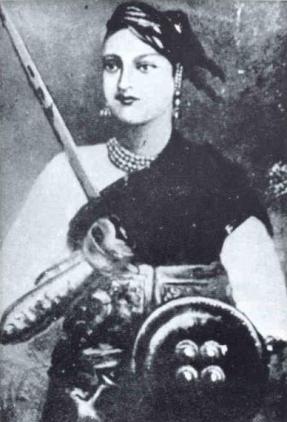
Rani Lakshmibai
Prominent leader of the 1857 Indian rebellion
The Rani of Jhansi, also known as Rani Lakshmibai, was one of the leading figures of the Indian Rebellion of 1857. The queen consort of the princely state of Jhansi from 1843 to 1853, she assumed its leadership after the outbreak of the conflict and fought several battles against the British. Her life and deeds are celebrated in modern India and she remains a potent symbol of Indian nationalism.
Shahzada Firoz Shah
Freedom Fighter
Shahzada Firoz Shah was a Mughal prince who took part in the 1857 revolution and fought the British very bravely.

Tantia Tope
Leader of the Indian War of Independence in 1857
Tantia Tope was an Indian general in the Indian Rebellion of 1857 against the British East India Company.
Turrebaz Khan
Rohilla freedom fighter and revolutionary during the Revolt of 1857
Turrebaz Khan, also known as Turram Khan, was an Indian Rohilla revolutionary who fought against the British in Hyderabad State during the Indian Rebellion of 1857 and was hung by the British.
Recommended Reading (1)

Inglorious Empire: What the British Did to India
by Shashi Tharoor
In the 18th century, India's share of the world economy was as large as Europe's. By 1947, after two centuries of British rule, it had decreased six-fold. Beyond conquest and deception, the Empire blew rebels from cannons, massacred unarmed protesters, entrenched institutionalized racism, and caused millions to die from starvation. British imperialism justified itself as enlightened despotism for the benefit of the governed, but Shashi Tharoor takes on and demolishes this position, demonstrating how every supposed imperial "gift" - from the railways to the rule of law - was designed in Britain's interests alone. He goes on to show how Britain's Industrial Revolution was founded on India's deindustrialization and the destruction of its textile industry. In this bold and incisive reassessment of colonialism, Tharoor exposes to devastating effect the inglorious reality of Britain's stained Indian legacy.
Inglorious Empire: What the British Did to India
by Shashi Tharoor