All Insights

Explore our complete collection of articles about India's history, culture, and science.

98 Y.O. British Solider Reveals TRUTH about India’s Partition | James M. Neilson

98 Y.O. British Solider Reveals TRUTH about India’s Partition | James M. Neilson

From the British Empire to Indian Independence, and from a soldier to an anesthesiologist, Dr. James M. Neilson shares his remarkable journey spanning nearly a century. Born in Scotland during the Great Depression, he served in the Indian Army, witnessed pivotal moments of history, and transformed his views on colonialism, democracy, and humanity. Join us as he reflects on life-changing events, regrets, and the heroes who shaped his philosophy.

View
What Indians Should know about Bharatiya Civilization | Dr. Raj Vedam

What Indians Should know about Bharatiya Civilization | Dr. Raj Vedam

Indian knowledge was transmitted to the world at various times via trade routes and travellers. India had rich legacy of relations with Europe and other parts of the world has been age old. Due to distortion of History by Colonial powers and Missionaries these facts have been over looked and a spurious Aryan Invasion theory has been propagated. Dr. Raj Vedam, through his deep research unravels the truths that Indians must know as their History.

View
Wonders of Ancient Indian Science & Technology | Dr Raj Vedam

Wonders of Ancient Indian Science & Technology | Dr Raj Vedam

When exploring the antiquity of Indian civilization, it’s crucial to rely on evidence-based knowledge rather than speculation. Ancient India was a pioneer in science and technology, with marvels like the Konark Temple and Kallanai Dam. India’s maritime knowledge, including advanced shipbuilding techniques, predates European achievements. The Bakshali Manuscript demonstrates ancient Indian knowledge of mathematics, including zero and linear programming. Ancient Indian medicine, optics, astronomy, metallurgy, and engineering innovations laid the foundation for modern technology, proving that current advancements stand on the shoulders of our ancestors.

View
Indian Philosophy - Shad Darshan

Indian Philosophy - Shad Darshan

This is an attempt to introduce very briefly Indian or Hindu philosophy . After introduction , each system is taken up independently in separate narration. The Sanskrit word for philosophy is darsana, which means direct vision. The words symbolize the difference between modern Western philosophy, which mainly relies on intellectual pursuit and Indian philosophy that relies on direct vision of truths and pure Buddhi (reasoning). Darsana is divided into two categories namely Astika (believer in the Vedas) and Nastika (non-believer in the Vedas). Astika are Nyaya, Vaisheshik, Sakhya, Yoga, Mimamsa and Vedanta. Nastika are Carvaka, Jainism and Buddhism. Others are a mixture of the ideas of these systems.

View
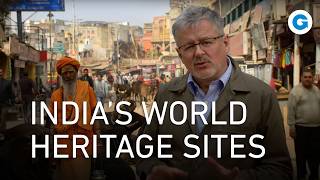
The Real Faces of India With Cristopher Clark

The Real Faces of India With Cristopher Clark

On this journey presenter Christopher Clark visits highlights of the diverse and historic UNESCO World Heritage Sites in India and tries to answer the question as to what unites the 1,4 billion people on the subcontinent. His path leads him from the chaotic city of Mumbai to the Himalaya, from the legendary Taj Mahal to the monumental castles and pompous palaces of Rajasthan.

View
Did The British Create India?

Did The British Create India?

Amish debunks the common misconception that India became a nation only under British rule, delving into historical evidence from ancient Indian manuscripts and foreigners’ travelogues that affirm India's long standing unity in diversity.

View
The Golden Road with William Dalrymple

The Golden Road with William Dalrymple

For a millennium and a half, India was a confident exporter of its diverse civilisation - creating around it a vast empire of ideas. Indian art, religions, technology, astronomy, music, dance, literature, mathematics and mythology blazed a trail across the world, along a Golden Road that stretched from the Red Sea to the Pacific. William Dalrymple draws from a lifetime of scholarship to highlight India’s position as the heart of ancient Eurasia and for the first time, he gives a name to this spread of Indian ideas that transformed the world. From the largest Hindu temple in the world at Angkor Wat to the Buddhism of Japan, from the trade that helped fund the Roman Empire to the creation of the numerals we use today (including zero), India transformed the culture and technology of its ancient world – and the world today as we know it. William Dalrymple is one of Britain’s most acclaimed and read historians and the bestselling author of the Wolfson Prize-winning White Mughals; The Last Mughal, which won the Duff Cooper Prize, and the Hemingway and Kapuscinski Prize-winning Return of a King. A frequent broadcaster, he has written and presented three television series, one of which won the Grierson Award for Best Documentary Series at BAFTA. He has also won the Thomas Cook Travel Book Award, the Sunday Times Young British Writer of the Year Award, the Foreign Correspondent of the Year at the FPA Media Awards and been awarded five honorary doctorates. He is a fellow of the Royal Society of Literature, the Royal Asiatic Society and the Royal Society of Edinburgh and has held visiting fellowships at Princeton and Brown. He was presented with the President’s Medal by the British Academy and was named one of the world’s top 50 thinkers for 2020 by Prospect Magazine. He is a founder and co-director of the Jaipur Literature Festival.

View
Hinduism as a Liberal Framework | Sanjeev Sanyal Explores Pluralism, Liberty & Tolerance

Hinduism as a Liberal Framework | Sanjeev Sanyal Explores Pluralism, Liberty & Tolerance

What connects Hinduism and Liberalism? Can ancient philosophies align with modern ideas of liberty, openness, and pluralism? Join Sanjeev Sanyal, renowned economist and author, as he delves into the architecture of Hinduism (Sanatan Dharma) and its parallels with Liberalism. Through captivating storytelling, he explores: The history and pluralistic essence of the Rigveda The Nasadiya Sukta's multidimensional views The Paradox of Tolerance and its modern relevance Why Liberalism must embrace skepticism and evolution Plus, discover thought-provoking book recommendations, including Friedrich Hayek’s works, and gain a fresh perspective on how Hinduism allows for the evolution of ideas—while questioning if it accepts everything.

View
Correcting Distorted Indian History with Neeraj Atri

Correcting Distorted Indian History with Neeraj Atri

In this podcast, Neeraj Atri, Chairman and National Head for Historical Research and Comparative Studies, joins Capt. Praveen Chaturvedi, CEO of Prachyam, will discuss his journey of challenging the distorted history presented in NCERT textbooks and taught under the CBSE curriculum. Neeraj Atri has been a leading voice in the campaign to correct what he views as "rigged" historical narratives, and this conversation delves into the motivations behind his work.

View
Who are the Indians? Debunking the Aryan Invasion Theory

Who are the Indians? Debunking the Aryan Invasion Theory

In this talk, Dr. Raj Vedam systematically breaks down the various accounts, both internal and external on the Aryan invasion theory. Multiple scientific facts have been presented in this articulate talk which in turn would help the viewers uncover deeper truths about a spurious theory promoted to break the unity of Bharat. Perspectives from genetics, genealogy, astronomy, history have been expressed in a simple yet impactful way in this lecture.

View
← Previous Page 1 of 4 Next →